Blue Ridge Parkway FAQs

Do you have questions about driving the Parkway, permits, and regulations? We have the answers! Our Frequently Asked Questions cover everything you need to know for a smooth trip. Find out when to visit, how to use the Travel Planner, and official policies for traveling along the Blue Ridge Parkway so you can plan a seamless adventure for all.
Where does the Blue Ridge Parkway start and end?
The Blue Ridge Parkway connects Shenandoah National Park to the Great Smoky Mountains National Park, stretching 469 miles from Rockfish Gap, VA to Cherokee, NC. Visitors can see the route and the many places to get on and off (access points) on our interactive map.
How do I get to the Parkway?
Google Maps recognizes Blue Ridge Parkway North Entrance and Blue Ridge Parkway – South End as the two ends of the Parkway, but it will not route you along the Parkway because it is a slow, scenic route. You can navigate to these points to get to the North or South ends of the Parkway, though.
Can I have a wedding or meeting/event on the Blue Ridge Parkway?
Yes, but special arrangements are required. Any planned event that provides a benefit to an individual, group, or organization — including weddings, ceremonies, commercial filming, meetings, or large group events — requires a Special Use Permit (SUP) from the National Park Service (NPS).
This permit ensures the protection of park resources and prevents conflict with regular public use. Factors that determine approval include the size of the event, the location, and the impact on traffic or visitors.
To get started, you must apply directly through the National Park Service:
- Small Events (like Elopements/Portraits): Even small ceremonies or professional photo shoots may require a permit.
- Large Events (Meetings/Runs/Walks): Events involving large groups, road closures, or commercial activity require thorough review.
Note: Fees and processing times vary, so apply well in advance of your desired date.
When are Visitor Centers, campgrounds, and Parkway facilities open?
The operating seasons vary significantly by facility. Since the Blue Ridge Parkway itself is open year-round (weather permitting), it is critical to check ahead for specific services.
Visitor Centers
- Main Season: Visitor Centers generally operate from May through October.
- Hours: Hours are typically 9:00 AM to 5:00 PM, but are subject to change. Always check the official NPS website or the Travel Planner App before you visit.
- Off-Season: Most centers are closed from November through April, though some may open for brief periods in the fall or on holidays.
Campgrounds
- Main Season: All Parkway campgrounds are typically open from May through October (the official Friday before Mother’s Day through the Monday after the last weekend in October). Always check the official NPS website or the Travel Planner App before you visit.
- Reservations: Reservations are highly recommended, especially during peak fall color season.
Other Facilities
- Parkway Road: The road itself is generally open 24/7, 365 days a year, but sections frequently close due to snow, ice, or construction (especially in winter). Always check the road conditions before travel.
- Concession Services: Lodges, restaurants, and other private concessioner operations maintain their own schedules.
Where can I find the latest information on Parkway detours and closings?
The most up to date closing information about the Blue Ridge Parkway can be accessed on the NPS closure chart.
Can tour buses and commercial vehicles travel on the Blue Ridge Parkway?
Commercial vehicles, including tour buses and large commercial passenger vans, are generally restricted on the Blue Ridge Parkway. This is primarily due to strict vehicle length and height restrictions imposed by the Parkway’s low, narrow tunnels and winding mountain grades.
Key Restrictions to Note:
- Tunnel Clearance: The Parkway features numerous tunnels with varying clearance heights. Drivers of buses and large recreational vehicles (RVs) must review the official tunnel clearance information before traveling, as many vehicles exceed the safe limits.
- Special Permits: Certain commercial activities or large groups may require a Special Use Permit (SUP) or a Commercial Use Authorization (CUA) from the National Park Service (NPS).
We strongly advise any tour operator or commercial driver to review all current regulations on the NPS website before planning a route on the Blue Ridge Parkway.
Can large RVs travel the Parkway?
Yes, Recreational Vehicles (RVs) can travel the Blue Ridge Parkway, but they face significant challenges, primarily due to numerous low and narrow tunnels, steep grades, and sharp curves. We strongly advise detailed planning before your trip.
Check Tunnel Clearances: It is critical to review the official list of all tunnel clearances on the Parkway. Many RVs exceed the safe height limits of the historic stone tunnels, especially those in the North Carolina section.
Planning ahead ensures safety for you and others and helps you avoid getting stuck.
Is parking adequate for large RVs and buses at Parkway scenic views and attractions?
Yes, but some areas have easier access and bigger parking lots than others.
Is the Blue Ridge Parkway open in winter?
Sections of the Parkway are closed in winter for safety reasons related to snow and ice, even when warmer down in the valleys. Refer to the NPS website for the most current conditions.
What is the speed limit on the Parkway?
Maximum is 45 miles per hour, with some locations (in congested areas such as Mabry Mill) at 35 miles per hour.
Why are there no white lines on the sides of the road?
This is a part of the design of the road itself and allows it to retain a rural feel and blend into the landscape. It is one of the touches that make this road beautiful. The landscape architects maintain this design and it meets federal safety standards.
Do Parkway campgrounds take reservations?
Yes, some sites can be reserved at www.recreation.gov or toll free at (877) 444-6777. Some sites at every NPS campground along the Parkway are first-come first-serve, so you aren’t required to have a reservation. But if you have a longer vehicle, it may be harder to find a suitable campsite, especially on a weekend, so reservations are recommended.
Do Parkway campgrounds accommodate RVs?
Yes, but water, electrical and sewage connections are not available. Centralized water and restrooms are available at open Parkway campgrounds.
Can I camp along the Parkway or at an overlook?
The only place along the Parkway that you can primitive camp without a permit is along the Appalachian Trail from Rockfish Gap (MP 0) to Dripping Rock (MP 9.6). Other overnight camping is only permissible at the eight Parkway campgrounds. More information is available on our camping page.
Are there any gas stations on the Parkway?
Not directly on the Parkway. Gas is available not far off the Parkway at most U.S. or State Highway Intersections. Explore our list of nearby gas stations.
Does the Appalachian Trail run parallel to the Parkway at any point?
Yes. In Virginia, North of Roanoke.
Where can I get information and brochures about traveling on the Parkway?
The Blue Ridge Parkway Association prints and provides brochures free of charge. The Blue Ridge Parkway Travel Planner and Blue Ridge Parkway Maps are included in a free information packet. You can also request motorcycling information and brochures from a number of area tourism agencies and attractions by completing the form here.
Can Parkway Rangers make an arrest or issue a citation?
Yes, they can. Blue Ridge Parkway Rangers are commissioned federal law enforcement officers of the National Park Service (NPS) and possess the authority to issue citations, conduct investigations, and make arrests for violations of federal and state laws.
Their primary duties include protecting visitors, park resources, and ensuring safety along the Parkway. Visitors must adhere to all regulations, including those concerning traffic, alcohol, camping, and resource protection.
How can I learn about local history along the Parkway?
You can purchase Parkway-related materials online, via telephone by calling (828) 299-3507, or the largest selection of materials is available at any open Blue Ridge Parkway Visitor Center. Operating dates and hours are available on the NPS website.
Is it alright to pull over on the grass beside the Parkway and spread a blanket for a picnic?
The National Park Service (NPS) prefers that visitors park in paved parking lots and overlooks rather than along the road shoulder as roadside parking damages park resources such as pavement edges and vegetation. Vehicles should be fully off of the road (and not blocking a gate) so they can be entered and exited without impeding the flow of traffic. Driving vehicles across open fields is prohibited. Please be respectful and do not park in wet areas or on the grass.
Explore all Parkway travel tips and regulations to plan your next great adventure.
Can I leave my car parked overnight at an overlook or visitor center?
Yes, but you must first notify Parkway Dispatch at (828) 298-2491 so your vehicle is not considered abandoned. We recommend that you choose a visible location, cover your valuables, lock your vehicle, and use caution.
What is a National Park Pass and how do I obtain one?
An annual pass available for $80 allows free entry to any National Park Service area with a fee. Anyone age 62 and over can purchase a Senior or Access Pass (annual or lifetime) which allows free entry into Parks with an entrance fee and often provides a 50% reduction for camping and other user fees. There is no fee to access the Blue Ridge Parkway, however, National Park Service Campgrounds along the Parkway do require a fee. Visitors with the Interagency Senior or Access Pass (or former Golden Age or Golden Access Passports) pay a reduced camping fee.
Passes (senior, military, annual, etc.) are only available at the campgrounds along the Parkway, not at the Visitor Centers. The closest campground to Asheville where passes may be purchased is Mt. Pisgah (828-648-2644). Parkway campgrounds are only open May through October. Other sites in North Carolina also offer the passes. We recommend that you call in advance to ensure they have the pass you’d like, verify hours, and confirm any documentation that you need to bring with you to secure the pass.
Is bicycling allowed on the Parkway?
Yes, bicycling is allowed on the roadway itself, though no biking is permitted on trails. Because the Blue Ridge Parkway was designed for motor travel, bicyclists should exercise caution, have reflectors, and riders should wear high visibility clothing and helmets. Avoid the Blue Ridge Parkway during fog and periods of low visibility. Long distance travelers should plan their overnight stays and be sure to have plenty of water and food. More information for bicyclists is available here.
What are the rules and regulations for Shenandoah National Park and Great Smoky Mountains?
Skyline Drive and Shenandoah National Park have entrance fees. Some backcountry camping is available. Contact the park at (540) 999-3500 for details.
Can we bury our pet along the Blue Ridge Parkway?
No. National Park Service (NPS) regulations prohibit pet burials on the Blue Ridge Parkway. We recommend checking the city nearest where you usually visited the Parkway for pet burial information so you could locate an appropriate location close to that city or town.
When is the best time to see fall color along the Parkway?
We recommend mid to late October, but it depends on your elevation and location. More information is available on our Fall Color page and our Story From the Road with tips on Finding Fall Color.
DOWNLOAD THE APP
Use our new app as a guide to help make your drive on the Parkway a safe and fun one.
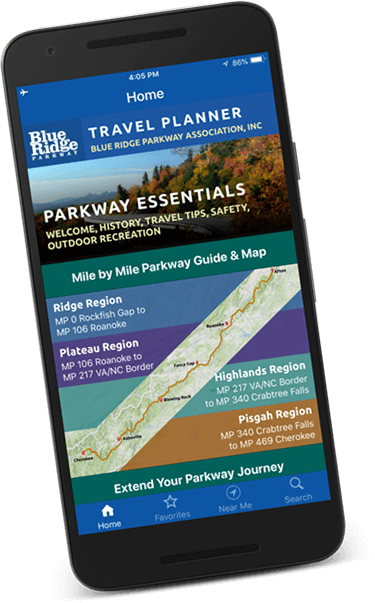
DOWNLOAD THE TRAVEL PLANNER
Map out your Parkway trip with a digital version of our complimentary travel guide.